




LI Focus on the economic effects of geopolitical disruptions published
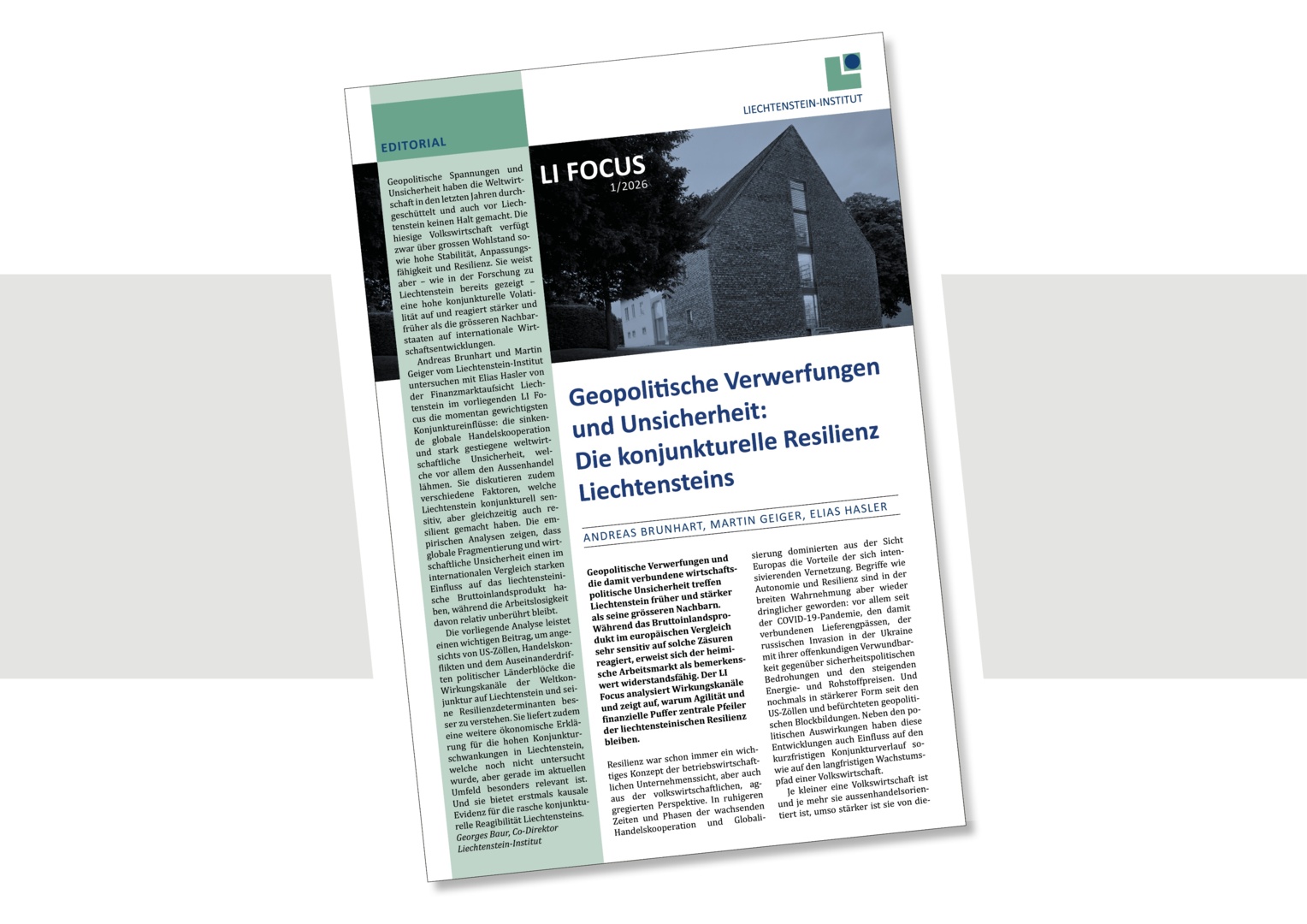
Liechtenstein’s economy is exceptionally dynamic and productive, characterized by stability and prosperity: its gross national income per capita is the highest in the world, unemployment is low, and both life expectancy and surveyed life satisfaction are high. Furthermore, public households are very solid with substantial reserves. However, in light of increasing geopolitical fragmentation and heightened economic uncertainty, Liechtenstein, like other European economies, currently faces significant challenges. As a very small and open economy, it is particularly exposed to global shocks, yet at the same time, it demonstrates a remarkable degree of resilience.
The high sensitivity of the Liechtenstein business cycle is reflected in the current stormy conditions of the global economy. A research project by the Liechtenstein Institute and the Financial Market Authority Liechtenstein shows that an increase in geopolitical fragmentation can dampen Liechtenstein’s real GDP within one quarter about three times more than in neighboring countries. The reaction of Liechtenstein’s GDP to a sudden spike in economic policy uncertainty is similarly pronounced.
Despite this strong GDP response, the impact on unemployment in Liechtenstein remains very limited by international standards. Notwithstanding current pressures, the Liechtenstein economy has so far proven to be similarly robust as it was during past economic turbulences. Long-standing experience with exposure to international shocks, efficient public and private structures, a strategic specialization in niche products, and the solid capitalization of many companies form strong pillars of resilience. However, it will be crucial to further strengthen innovative capacity. In a world of increasing geopolitical tensions, it becomes clear – especially for small states – that resilience is not a state of being, but a continuous process.


