




GDP estimate for 2025: Economic slowdown with a significant decline in GDP
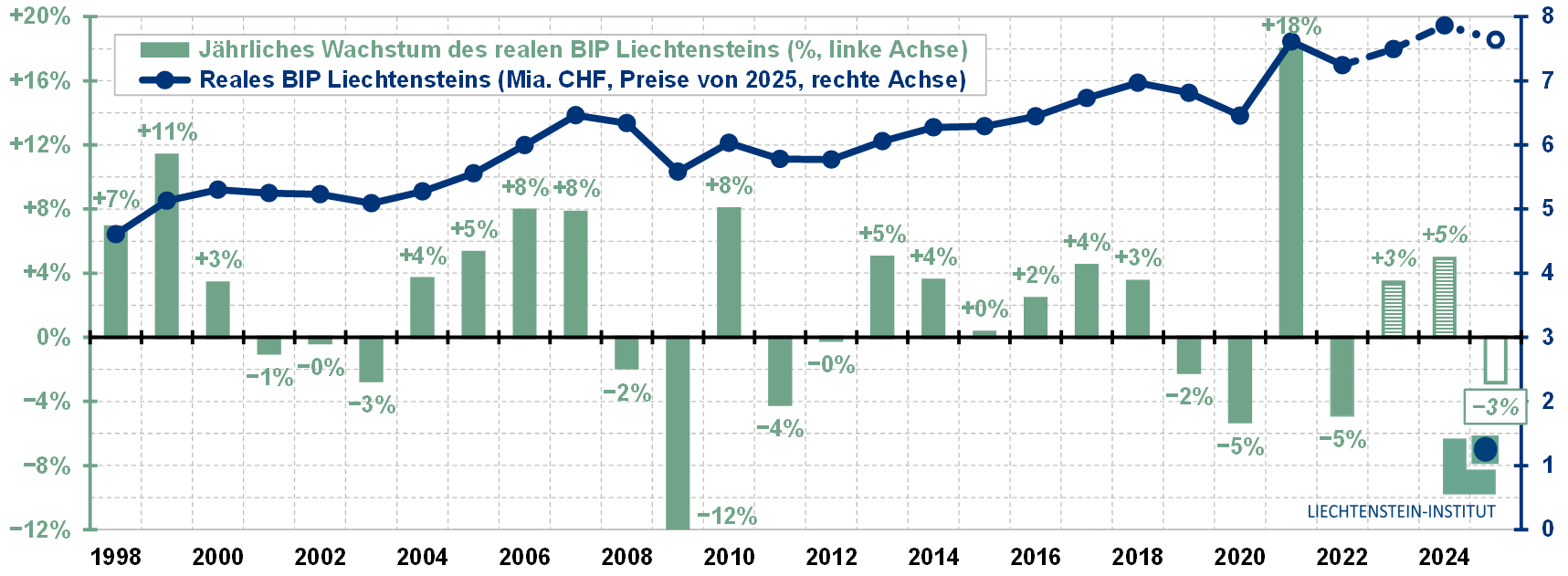
The 2025 GDP estimate is generated using a statistical model and is subject to a high degree of uncertainty: on the one hand due to the high economic volatility of recent years, and on the other hand due to expectable revisions in the national accounts to the GDP value of the official preliminary estimate 2024, some of which are quite substantial in the past.
Gross domestic product (GDP) is a key figure for various economic analyses and estimates. GDP does have limitations in terms of long-term welfare considerations and should be supplemented by other indicators for a comprehensive assessment. However, GDP and other national accounts indicators are central to economic policy analysis as historically established and internationally comparable concepts and are indispensable for productivity and business cycle analysis.
To improve the data situation, the Liechtenstein-Institute publishes an annual GDP estimate. This provides an initial value for the previous year’s GDP almost a full year before the official preliminary GDP estimate released by the Office of Statistics. A time series analysis model with national and international economic variables is used, which have a high correlation with Liechtenstein’s GDP and are available very early on. As the economic indicators used are published with sub-annual frequency, the model also estimates quarterly GDP (back to 1998). This is another important supplement to the official national accounts, which are only available on an annual basis. For economic and growth analysis, real (price-adjusted) GDP is more relevant than the officially published nominal GDP. For this reason, the Liechtenstein-Institute calculates real data and calibrates its estimation model to it. To ensure comparability with the data published by the Office of Statistics, nominal values are also derived and reported.
Due to Liechtenstein’s very high economic volatility, the sparse data basis and, in some cases, major revisions of already published official figures, the GDP estimate should be interpreted as an initial approximation. The GDP estimate is a module of the «Applied Economic Analysis», which is supported by the government of the Principality of Liechtenstein. It appeared for the first time in 2021 and is published annually at the end of March.


